
🔍 Read the full analysis: AI In A World That Once Revolved Around Farming on ThorstenMeyerAI.com

Get business pricing on monitors, keyboards and dev gear
- Business-only prices and quantity discounts
- Tax-exempt purchasing
- Multiple users, one account, clear invoices
TL;DR
A November 3, 2026, article from ThorstenMeyerAI.com traces how mechanization, fertilizer and higher-yield crops sharply reduced agriculture’s share of work in some countries while food production rose. Its author uses farming as a comparison for AI automation, but the forecast that AI could automate most work in some sectors is a thesis, not an established outcome.
ThorstenMeyerAI.com published an analysis on November 3 tracing how farming moved from employing most workers in some countries to a small share of the workforce, while agricultural output grew. The article uses that history to consider AI and future automation, while acknowledging that its prediction of sector-wide automation is a thesis, not a confirmed forecast.
The article cites an estimate by economic historian Stanley Lebergott, published by the U.S. Census Bureau, that 1.4 million of the 1.9 million people in the American labor force in 1800 worked in agriculture: 73.7 percent. The figures for years before 1840 are estimates, not census counts, and the historical labor force included enslaved people. The author therefore describes the early U.S. share as roughly three in four, rather than treating the estimate as an exact count.
The change unfolded over generations through a series of developments, the article says, including improved ploughs and machinery, synthetic fertilizer and higher-yield crop varieties. It cites U.S. wheat production rising from 12.3 million tonnes in 1964–65 to 26.4 million tonnes in 1971–72, alongside the introduction of short-straw wheat in India and Pakistan. The source also reports that the world cereal harvest grew 4.2-fold from 1961 while the population grew 2.7-fold; those figures describe separate changes over that period, not a measure of output per worker.
The article gives a current global estimate of 928 million people working in agriculture, or about one in four workers worldwide, citing the International Labour Organization’s 2025 estimate. Agriculture’s share varies widely: the source puts it at 43 percent of workers in India, about 1.5 percent in the United States and about 1 percent in Germany. Those differences show that the historical shift is not complete or uniform.
Farming’s Lessons for AI Automation
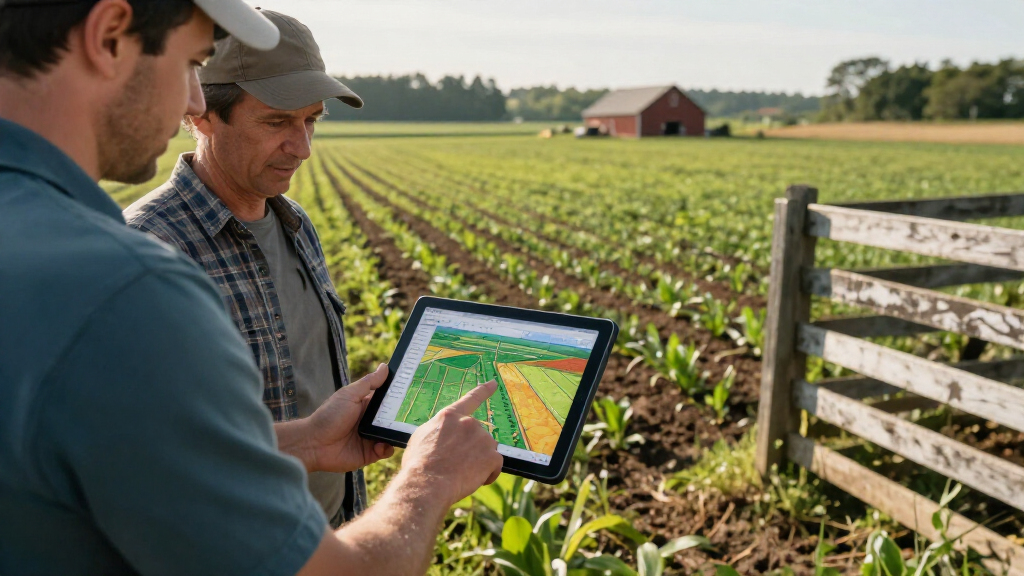
The history matters because it offers a concrete example of productivity growth changing the mix of work. As tools, farm inputs and crop varieties improved, a smaller share of workers could produce more food. That challenges the simple assumption that fewer workers in a sector must mean less output: the source says U.S. farm output in 2023 was nearly three times its 1948 level, with only a small rise in total inputs.
For readers weighing claims about AI, the comparison gives both a possibility and a caution. Farming shows that technology can sharply reduce the labor needed for a task or industry. But the shift took a long time, happened through multiple advances, and did not unfold at the same pace everywhere. It does not establish how many jobs AI will replace, how quickly that may happen, or whether workers displaced from one kind of work will find comparable jobs elsewhere.
Those distinctions matter for workers, businesses and policymakers. A productivity gain can raise output without automatically resolving who benefits, how employment changes, or whether people can move into new roles. The farming example is relevant as historical evidence of structural change, not as a direct forecast for AI’s effects.
Products Worth Considering

Anker SOLIX C1000 Gen 2 Portable Power Station

Logitech MX Keys S Wireless Keyboard, Graphite

Logitech MX Mechanical Wireless Illuminated Keyboard, Tactile Quiet, Graphite
As an affiliate, we earn on qualifying purchases.
From Muscle to Modern Farming
The article’s account begins with a basic constraint: before industrial tools and modern inputs, food production depended heavily on human and animal labor. It cites historical estimates placing agriculture’s share of workers at about 85 percent in Japan in 1872, 83.5 percent in China in 1952 and 69.7 percent in India in 1951. The measures are not identical across countries: some count the broader primary sector, and the source notes that historical methods and definitions vary.
In the United States, agriculture’s share of workers fell before the number of farm workers itself began to decline. The source says the American farm workforce continued rising until about 1910, when it reached 11.8 million. In Germany, it reports that agriculture’s share dropped from 43 percent to 25 percent between 1882 and 1939 while the number of farm workers remained between 8 million and 10 million. These examples distinguish a sector’s shrinking share of the workforce from an immediate fall in its headcount.
The technical changes came in stages. A steel plough associated with John Deere in 1837 addressed difficulties working sticky Midwestern soil; later came mechanical equipment. The source then describes synthetic ammonia production, beginning with Fritz Haber’s 1908 patent, and the spread of higher-yield crops in the 20th century. It presents these developments as a long sequence, rather than a single moment when farming became automated.
“The share fell long before the headcount.”
— Thorsten Meyer, ThorstenMeyerAI.com
Limits of the AI Comparison
The article offers historical evidence about agriculture, but it does not establish a forecast for AI. Its suggestion that automation could reach as much as 90 percent of a sector within a decade or a few decades is explicitly identified as the author’s thesis. The source does not define precisely what “a sector” or “automated” means in that estimate, or provide a method for calculating it.
It is also unclear from the material provided how AI-driven changes would compare with farming’s long transition in pace, affected occupations and job creation elsewhere. Agricultural statistics measure different countries, periods and categories, and the cited output increases do not by themselves show how gains were distributed among workers, owners and consumers. The future employment effects of AI remain unsettled.
Further Installments on Work
The piece is identified as Episode 2 of “Work After Work,” Arc 1, a series about how the economy is built. Meyer says the next installment, Episode 3, will cover agricultural machinery, including reapers, threshers and tractors. That installment may add detail to the farming history, but the source does not give a publication date.
For now, the article’s central contribution is a historical comparison: farming became far less labor-intensive through accumulated technical and biological changes, while production grew. Whether AI will produce a comparable shift across other sectors, and on what timeline, remains a question rather than a settled result.
Key Questions
What is the news in this article?
ThorstenMeyerAI.com published a historical analysis connecting agriculture’s long-term workforce decline with current discussions about AI and automation.
How many Americans worked in agriculture around 1800?
The article cites a Census Bureau-published estimate that 73.7 percent of the U.S. labor force worked in agriculture in 1800. It notes that the figure is a historical estimate, not a census count, and includes enslaved people.
Does the article say AI will automate 90 percent of a sector?
No. The author presents that possibility as a personal thesis, not a fact. The source does not establish that the prediction will happen or specify a firm timeline.
How many people still work in agriculture worldwide?
The article cites an International Labour Organization estimate for 2025 of 928 million people, about one in four workers worldwide. It reports that agriculture’s share differs substantially by country.
What happens in the next installment?
The author says Episode 3 will cover agricultural machinery, including reapers, threshers and tractors. No release date is provided in the source material.
Source: ThorstenMeyerAI.com