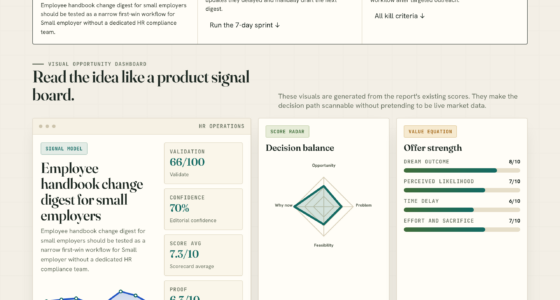
📊 Full opportunity report: Image Search Tools For Secondhand Marketplace Finds on IdeaNavigator AI — validation score, market gap, and execution plan.

Get business pricing on monitors, keyboards and dev gear
- Business-only prices and quantity discounts
- Tax-exempt purchasing
- Multiple users, one account, clear invoices
TL;DR

A product concept proposes one photo or keyword search for used listings across two or three marketplaces, with results ranked by price. It is a proposed test, not a launched service: the suggested validation is to manually handle requests from 20 shoppers and measure clicks and preferences.
IdeaNavigator AI has proposed testing a shopping tool that would let people search for a specific secondhand item with a photo or keyword across two or three marketplaces and compare matching listings by price. The proposal describes an early-stage product idea, not a service that has launched or a study showing that shoppers want it.
The concept targets deal-seeking shoppers looking for a particular used item. Today, shoppers may need to repeat a search across platforms such as eBay, Facebook Marketplace, and Mercari, as well as other resale sites. The proposed tool would bring selected results into one view, using an uploaded image or text query to find potential matches.
The suggested first version would search only two or three major marketplaces and rank listings by price. The proposal says image-recognition models are now inexpensive and accurate enough to match product photos, but provides no benchmark, test results, or independent evidence to support that assessment. It also does not specify how the tool would access marketplace listings or identify listings that are similar but not the same item.
To test demand before building the product, IdeaNavigator AI suggests manually fulfilling image-match requests for 20 shoppers across three marketplaces. The proposed measures are whether users click through to listings and whether they prefer the aggregated results. This is a suggested validation plan; no completed test, user feedback, or click-through figures are reported.
One Search Across Resale Sites
A unified search could reduce the repeated effort involved in checking separate resale platforms, while making it easier to compare prices for similar used items. That may help shoppers who already know what they want but face fragmented listings and different search tools on each marketplace. Whether a combined view actually saves time or improves purchase decisions remains to be tested.
The proposal also points to a potential affiliate commission model: the tool could earn money when users complete purchases through marketplace links. That would make its business prospects dependent not just on finding relevant results, but on shoppers clicking through and buying. The suggested small manual trial could offer an early indication of interest, but would not establish broad demand or long-term commercial viability.
As an affiliate, we earn on qualifying purchases.
Why Resale Search Is Fragmented
The idea addresses a specific inconvenience in secondhand shopping: inventory is distributed across marketplaces that generally present their own listings and search results. A shopper looking for one particular object may need to run the same query on several sites, and a photo-based search could be useful when the shopper does not know the item’s exact name or description.
However, the proposal does not report partnerships with marketplaces, technical integrations, or access to their inventory. It names eBay, Marketplace, and Mercari as examples of places shoppers search, but does not say which services would be included in an initial product. Nor does it provide evidence that visual matching works consistently across different photographs, listing conditions, or product variations.
used marketplace price comparison device
As an affiliate, we earn on qualifying purchases.
As an affiliate, we earn on qualifying purchases.
Demand and Matching Remain Untested
No product launch, user trial, or performance results are described. It is not clear whether marketplaces would permit listings to be gathered and displayed in this way, how frequently results could be updated, or how the tool would handle removed listings and duplicate posts. The proposal also leaves open how it would distinguish an exact match from a visually similar item, and whether ranking by price would account for shipping, condition, or other costs.
The claim that current visual-search models are affordable and accurate enough for this use is not accompanied by specific model details, costs, or accuracy measurements. The proposed 20-person manual test may help identify whether users engage with aggregated results, but its scale and three-marketplace scope would not settle how the service performs across the broader resale market.
As an affiliate, we earn on qualifying purchases.
A Small Manual Trial Comes First
The next step described in the proposal is to manually search for image matches for 20 shoppers across three marketplaces, then record click-through behavior and whether shoppers prefer the combined results. No schedule, recruitment plan, or criteria for judging success are provided.
If such a test takes place, its results could help determine whether to build a limited search tool and which marketplaces to include. Until results or a launch announcement are available, the idea remains a proposed workflow for testing, rather than a confirmed new shopping service.
Source: IdeaNavigator AI
As an affiliate, we earn on qualifying purchases.
Key Questions
Has a cross-marketplace secondhand photo-search tool launched?
No launch is reported. The proposal describes a product idea and a possible early test, not an available service.
How would the proposed search work?
A shopper would upload a photo or enter keywords. The proposed first version would return matching used listings from two or three marketplaces, ranked by price.
Which marketplaces would it search?
The idea names eBay, Facebook Marketplace, and Mercari as examples of platforms shoppers currently search, but does not confirm which marketplaces would be included in a product or test.
How would the idea be tested?
The suggested test is to manually fulfill image-match requests for 20 shoppers across three marketplaces and measure clicks and user preference. No results or test date are given.
How might the tool make money?
The proposed business model is affiliate commission on completed marketplace purchases. The idea does not provide commission rates or evidence of commercial viability.
Source: IdeaNavigator AI
Evergreen bestsellers Picks
bestsellers
As an affiliate, we earn on qualifying purchases.