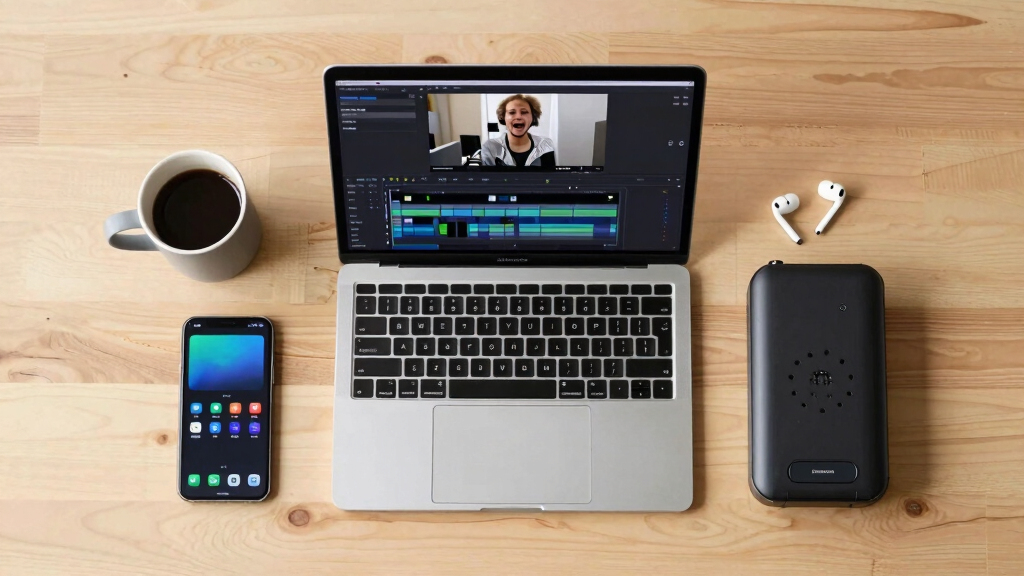

📊 Full opportunity report: One Video In, a Whole Publishing Kit Out — Without the Cloud on ThorstenMeyerAI.com — validation score, market gap, and execution plan.

Get business pricing on monitors, keyboards and dev gear
- Business-only prices and quantity discounts
- Tax-exempt purchasing
- Multiple users, one account, clear invoices
TL;DR
A new approach allows creators to generate a full set of publishing assets from a single video entirely offline. This method improves workflow speed, enhances privacy, and cuts costs by avoiding cloud services.
A new software tool allows users to generate an entire publishing kit—including titles, clips, descriptions, and social media posts—from a single video entirely offline, eliminating the need for cloud services. This approach is detailed in the original analysis. This development offers faster workflows, increased privacy, and cost savings for content creators and teams handling sensitive material.
The tool analyzes videos by transcribing speech, detecting scene changes, reading on-screen text, and identifying visual elements—all locally on the user’s hardware. It then combines this data to produce a set of assets such as optimized titles, social media snippets, thumbnails, transcripts, and clips, which can be reviewed and edited before publishing. The process is designed for speed, with layered progress indicators allowing creators to work efficiently without waiting for cloud-based processing.
Compared with traditional cloud workflows, which depend on internet speed and incur recurring costs, this local-first approach offers immediate processing times limited only by hardware capabilities. For example, a mid-range PC with a decent GPU can generate a complete set of assets for a 20-minute video in under 10 minutes, with no ongoing cloud fees. Hardware investments, such as a powerful desktop with at least 16GB RAM and an SSD, are sufficient for most creators to implement this workflow effectively.
Advantages of Offline Asset Generation for Creators
This development matters because it addresses key pain points for content creators: long turnaround times, high costs, and privacy concerns associated with cloud-based tools. For more insights, see the related internal page. By enabling complete asset creation offline, creators can work faster, save money on subscription fees, and maintain full control over their data. This shift could redefine content production workflows, especially for teams handling sensitive or proprietary material, and reduce dependence on third-party cloud providers.
As an affiliate, we earn on qualifying purchases.
Rise of Local AI Tools and Workflow Optimization
Recent trends show increasing adoption of local AI tools in content creation, driven by demands for faster processing, privacy, and cost efficiency. Learn more about this shift in the original analysis. Traditionally, cloud platforms have dominated automated content generation, but recent software releases highlight a move toward local solutions that leverage powerful consumer hardware. This shift is part of broader efforts to empower creators with more control and reduce reliance on external servers, especially amid growing concerns over data security and recurring expenses.
“This tool transforms the way creators handle video content, allowing them to produce a full publishing kit offline, instantly, and securely.”
— Thorsten Meyer, developer of the new software
As an affiliate, we earn on qualifying purchases.
Unanswered Questions About Software Capabilities and Adoption
It remains unclear how widely adopted this new software will become and whether it will support all types of content or require specific hardware configurations. Details about long-term support, integration with existing platforms, and potential limitations in processing complex videos are still emerging. Additionally, the scalability for large teams or enterprise use has not been fully addressed.
local AI video processing software
As an affiliate, we earn on qualifying purchases.
As an affiliate, we earn on qualifying purchases.
Next Steps for Developers and Content Creators
Developers are expected to release updated versions with broader platform support and enhanced features. Content creators should evaluate their hardware setup to leverage this workflow effectively. Industry observers will monitor adoption rates and whether this approach influences the broader ecosystem, potentially prompting cloud providers to innovate or adapt their offerings.
video transcription and clipping software
As an affiliate, we earn on qualifying purchases.
As an affiliate, we earn on qualifying purchases.
Key Questions
Can this software handle all video formats?
While initial versions support common formats like MP4 and MOV, support for additional formats may be added in future updates. Compatibility details are expected to be announced by the developers.
Is there a cost associated with this offline tool?
The software may require a one-time purchase or license fee. Hardware costs depend on existing setups, but there are no recurring cloud fees involved.
How does offline processing compare in quality to cloud-based AI?
Preliminary reports suggest comparable quality for most common tasks such as transcription and clip detection, but performance may vary depending on hardware specifications and video complexity.
Will this tool integrate with popular editing platforms?
Integration plans are not yet confirmed, but developers aim to support export options compatible with major editing and publishing platforms.
Is this solution suitable for large-scale production teams?
While designed primarily for individual creators and small teams, scalability features are under development, and enterprise-level support may be introduced later.
Source: ThorstenMeyerAI.com
Fall Picks
fall essentials
As an affiliate, we earn on qualifying purchases.