The Keychron C2 is my best overall pick for programming because its full-size layout and brown switches give typists a familiar, practical starting point. For a more compact desk setup, the Kisnt KN85 adds wireless connectivity and hot-swappable switches, while the RK Royal Kludge S98 pairs wireless use with a knob and smart display. The main tradeoffs are layout size, switch feel, and wired versus wireless use: extra keys can help with navigation, while compact boards save desk space. Features such as hot-swappable switches offer room to customize, but are less useful if you want a keyboard that works well without changes. Read on for the full comparison and guidance on matching a keyboard to your coding routine.

Get business pricing on monitors, keyboards and dev gear
- Business-only prices and quantity discounts
- Tax-exempt purchasing
- Multiple users, one account, clear invoices
Key Takeaways
- The Keychron C2 is the most straightforward programming choice in this group: it is a full-size wired board with brown switches, rather than a gaming-first model built around lighting or macros.
- The Kisnt KN85 and RK Royal Kludge S98 offer the clearest compact-versus-feature-rich split: the KN85 is a 75% wireless option with hot-swappable linear switches, while the S98 adds a display and knob.
- Hot-swapping appears on several Redragon picks, including the K668 and K671, giving switch-curious buyers room to change feel without replacing the whole keyboard.
- Full-size layouts dominate the lineup, which suits programmers who rely on a number pad but leaves fewer space-saving choices beyond the 75% KN85 and the 96-key models.
- Not every keyboard with a mechanical-sounding name is mechanical: the AULA S99 is listed as a membrane keyboard, so it does not match the roundup’s mechanical-keyboard brief.
| AULA S99 99-Key Wireless RGB Membrane Gaming Keyboard |  | Best for Programmers Who Need a Numpad and Wireless Flexibility | Layout: 96%, QWERTY | Keys: 99 | Switch type: Membrane | VIEW LATEST PRICE | See Our Full Breakdown |
| Redragon K580 Wired RGB Mechanical Gaming Keyboard with Macro Keys and Media Wheel |  | Best for Programmers Who Want Dedicated Macros | Layout: Full-size | Keys: 104 | Switch type: Outemu Blue, hot-swappable | VIEW LATEST PRICE | See Our Full Breakdown |
| Meidosa AK96 96-Key Wired Mechanical Keyboard with Smart Display and Knob |  | Best Compact Mechanical Numpad | Layout: 96-key QWERTY | Switch type: Clicky Blue, hot-swappable | Connectivity: USB-C wired | VIEW LATEST PRICE | See Our Full Breakdown |
| Kisnt KN85 75% Wireless Mechanical Keyboard, Tri-Mode Connectivity, RGB Backlighting, Hot-Swappable Linear Switches, Retro Beige |  | Best Compact Wireless Mechanical Keyboard | Layout: 75%, 85-key QWERTY | Switches: Pre-lubed linear, 45–50 gf actuation | Hot-swap compatibility: 3-pin and 5-pin switches | VIEW LATEST PRICE | See Our Full Breakdown |
| Logitech G413 SE Full-Size Mechanical Gaming Keyboard |  | Best Straightforward Full-Size Pick | Layout: Full-size QWERTY | Keys: 108 | Switch type: Tactile mechanical | VIEW LATEST PRICE | See Our Full Breakdown |
| AULA F2088 Wired Mechanical Gaming Keyboard, 104 Keys |  | Best for Clicky Typing Feedback | Model: F2088 | Switch type: Blue mechanical | Keys: 104 | VIEW LATEST PRICE | See Our Full Breakdown |
| RK Royal Kludge S98 Wireless Mechanical Keyboard with Smart Display and Knob |  | Best Compact Wireless Pick | Switch type: Pre-lubed linear RK switches | Hot-swappable: Yes | Keycaps: Double-shot PBT | VIEW LATEST PRICE | See Our Full Breakdown |
| Redragon K668 108-Key Hot-Swappable Wired RGB Gaming Keyboard |  | Best for Shortcut Customization | Model: K668 | Number of keys: 108 | Layout: QWERTY | VIEW LATEST PRICE | See Our Full Breakdown |
| Redragon K671 Wired Mechanical Gaming Keyboard with Hot-Swappable Red Switches |  | Best Straightforward Full-Size Value | Connectivity: Wired | Switch type: Linear red | Hot-swappable: Yes | VIEW LATEST PRICE | See Our Full Breakdown |
| wegear 104-Key Wired Mechanical Gaming Keyboard with Clicky Blue Switches |  | Best for a Simple Clicky Full-Size Setup | Model: GK1-MK | Number of keys: 104 | Switch type: Clicky Blue | VIEW LATEST PRICE | See Our Full Breakdown |
| Keychron C2 Full-Size Wired Mechanical Keyboard with Brown Switches |  | Best for Full-Size Tactile Typing | Layout: Full-size QWERTY, 104 keys | Switches: Keychron Brown, tactile | Connection: Wired USB-C | VIEW LATEST PRICE | See Our Full Breakdown |
| Newmen GM325 Pro Full-Size Mechanical Gaming Keyboard with Linear Red Switches |  | Best for Remapping and Macros | Layout: 104 keys; listing conflicts between QWERTY and AZERTY | Switches: Linear Red | Connectivity: Wired USB-C | VIEW LATEST PRICE | See Our Full Breakdown |
| AULA F99 Tri-Mode Wireless Mechanical Keyboard | 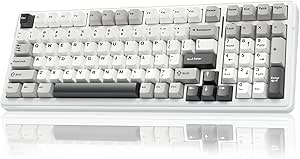 | Best for Multi-Device Programming | Layout: 99-key, 96% compact; AZERTY | Switches: Pre-lubed linear, hot-swappable | Connectivity: Bluetooth 5.0, 2.4 GHz wireless, and USB-C | VIEW LATEST PRICE | See Our Full Breakdown |
| mechanical keyboards for programming | Connectivity | Layout | Backlighting | Compatibility |
|---|---|---|---|---|
| AULA S99 99-Key Wireless RGB M | Bluetooth 5.0, 2.4 GHz wireless, USB-C wired | 96%, QWERTY | RGB | Windows, Mac, Android, iOS |
| Redragon K580 Wired RGB Mechan | Wired USB-C | Full-size | RGB | Linux, macOS, Windows |
| Meidosa AK96 96-Key Wired Mech | USB-C wired | 96-key QWERTY | RGB, 17 modes | PC, Mac |
| Kisnt KN85 75% Wireless Mechan | USB-C, 2.4 GHz wireless, Bluetooth 5.0 | 75%, 85-key QWERTY | — | Windows, macOS, Android, Linux |
| Logitech G413 SE Full-Size Mec | Wired USB 2.0 | Full-size QWERTY | Single-color white LED | — |
| AULA F2088 Wired Mechanical Ga | Wired USB | — | 19 lighting effects and 3 customizable effects | Windows, Linux, Mac OS |
| RK Royal Kludge S98 Wireless M | Bluetooth 5.0, 2.4 GHz RF dongle, USB-C wired | — | RGB | — |
| Redragon K668 108-Key Hot-Swap | Wired USB-C | QWERTY | RGB, 19 preset modes | PC and laptop; Windows operating system listed |
| Redragon K671 Wired Mechanical | Wired | QWERTY | 11 modes; brightness and speed adjustable | — |
| wegear 104-Key Wired Mechanica | USB-A | QWERTY | RGB, 11 modes, 5 brightness levels | Windows PCs and laptops |
| Keychron C2 Full-Size Wired Me | — | Full-size QWERTY, 104 keys | Non-backlit | macOS and Windows |
| Newmen GM325 Pro Full-Size Mec | Wired USB-C | 104 keys; listing conflicts between QWERTY and AZERTY | — | Windows; laptops and PCs |
| AULA F99 Tri-Mode Wireless Mec | Bluetooth 5.0, 2.4 GHz wireless, and USB-C | 99-key, 96% compact; AZERTY | RGB with 16 lighting effects | Windows; listed for consoles, laptops, PCs, smartphones, and tablets |
More Details on Our Top Picks
AULA S99 99-Key Wireless RGB Membrane Gaming Keyboard
The S99 is the lineup’s flexible desk option: its 96% layout keeps a numeric keypad while taking less room than a full-size board, and Bluetooth, 2.4 GHz, and USB-C let you switch between devices or work wired. Macro programming, three shortcut keys, and a dual-mode knob add ways to streamline repeated tasks. That feature mix suits a programmer who values compactness and device switching more than a mechanical typing feel.
There is a clear caveat: despite a product title that may suggest otherwise, the supplied specifications identify membrane switches, which are not hot-swappable. Compared with the mechanical Kisnt KN85, the S99 gives you a numpad and broader built-in connectivity, but not the same switch customization. Choose it for its layout and flexibility, not for a mechanical-keyboard upgrade.
Pros:- 96% layout retains a numeric keypad while reducing the footprint versus full-size boards.
- Bluetooth, 2.4 GHz wireless, and USB-C wired connectivity support different desk setups.
- Macro programming, three shortcut keys, and a dual-mode knob provide extra controls.
- Foldable two-stage stand allows adjustment of the typing angle.
Cons:- Membrane switches are not mechanical and cannot be hot-swapped.
- The product information is inconsistent about the switch type, so buyers seeking a mechanical board should verify before choosing.
- Battery-powered wireless use adds charging or battery upkeep compared with the wired K580.
Best for: Programmers who regularly enter numbers, use multiple devices, and prefer a compact board with wireless and wired connection options.
Not ideal for: Programmers set on mechanical switches, hot-swapping, or a consistent mechanical typing feel; the listed switches are membrane and cannot be swapped.
- Layout:96%, QWERTY
- Keys:99
- Switch type:Membrane
- Connectivity:Bluetooth 5.0, 2.4 GHz wireless, USB-C wired
- Backlighting:RGB
- Programmable controls:Full-key macro programming, three shortcut keys, dual-mode rotary knob
- Stand:Foldable two-stage stand
- Compatibility:Windows, Mac, Android, iOS
Our verdict“Pick the S99 if you want a compact numpad, programmable controls, and three connection modes, but skip it if mechanical switches are a requirement.”
Redragon K580 Wired RGB Mechanical Gaming Keyboard with Macro Keys and Media Wheel
The K580 makes the strongest case for a programmer who wants dedicated macro controls without giving up a full-size layout. Five separate macro keys and a media wheel keep common actions and audio adjustments close at hand, while the 104-key arrangement includes a numpad. Its hot-swappable Outemu Blue switches also offer a route to change the feel later, a flexibility the Logitech G413 SE does not list.
The tradeoff is a distinctly clicky, wired setup. Blue switches can carry into shared rooms, and the K580 has no wireless mode for a clean, movable desk. Its macro keys and media controls may also occupy space that a minimalist coding setup would prefer to leave clear. Compared with the compact Kisnt KN85, this Redragon favors dedicated controls and a numpad over desk space and wireless convenience.
Pros:- Five dedicated macro keys provide quick access to repeated commands.
- Media wheel and controls allow audio adjustment without leaving the keyboard.
- Hot-swappable Outemu Blue switches allow switch changes without replacing the whole board.
- Full-size layout includes a numeric keypad and anti-ghosting.
Cons:- Wired-only connectivity offers less placement and device flexibility than the Kisnt KN85.
- Clicky blue switches may disturb nearby coworkers or household members.
- Advanced RGB effects require software.
Best for: Programmers who use repeated shortcuts or macros, need a numpad, and work at a fixed desk where audible switches are acceptable.
Not ideal for: People coding in quiet shared spaces or switching between devices; its blue switches can be loud and it is wired only.
- Layout:Full-size
- Keys:104
- Switch type:Outemu Blue, hot-swappable
- Connectivity:Wired USB-C
- Backlighting:RGB
- Controls:Five macro keys and media wheel
- Materials:ABS and aluminum
- Compatibility:Linux, macOS, Windows
Our verdict“Choose the K580 for a numpad, dedicated macro keys, and switch customization at a fixed workstation, but avoid it if noise or wireless use matters.”
Meidosa AK96 96-Key Wired Mechanical Keyboard with Smart Display and Knob
The AK96 is a useful middle ground for programmers who need arrow keys and a numpad but want a smaller footprint than the 104-key Redragon K580. Its 96-key layout keeps those navigation and number-entry tools together, and full key rollover supports simultaneous key presses. USB-C wired connection keeps the setup simple; adjustable kickstands let you set the board’s angle rather than relying on a fixed position.
Its clicky blue switches are the defining compromise. They provide pronounced auditory and tactile feedback, but that sound can be a poor fit for shared offices or late-night work. The plastic enclosure and lack of water resistance also make this a more basic choice than the aluminum-topped Logitech G413 SE. Choose the AK96 for compact key coverage and mechanical customization, not for a quiet, spill-resistant workstation.
Pros:- 96-key arrangement retains arrow keys and a numpad in less space than a full-size layout.
- Hot-swappable mechanical switches allow future switch changes.
- Full key rollover supports simultaneous key presses.
- Adjustable kickstands and non-slip pads help with desk positioning.
Cons:- Clicky blue switches can be disruptive in shared work areas.
- Wired USB-C connection does not offer wireless device switching.
- Plastic enclosure is not water resistant.
Best for: Programmers who need arrow keys and a numpad in a compact wired layout and prefer clicky feedback.
Not ideal for: Quiet-office users or anyone who wants spill protection, wireless connectivity, or a sturdier metal enclosure.
- Layout:96-key QWERTY
- Switch type:Clicky Blue, hot-swappable
- Connectivity:USB-C wired
- Backlighting:RGB, 17 modes
- Key rollover:Full
- Enclosure:Plastic
- Dimensions:5.7 × 16.9 × 1.7 in
- Compatibility:PC, Mac
Our verdict“Pick the AK96 if you want compact mechanical key coverage with a numpad, but choose a quieter or water-resistant alternative for shared, spill-prone desks.”
Kisnt KN85 75% Wireless Mechanical Keyboard, Tri-Mode Connectivity, RGB Backlighting, Hot-Swappable Linear Switches, Retro Beige
The KN85 is the clearest choice here for programmers trying to free desk space without losing arrow keys or the function row. Its 75% layout is smaller than the Meidosa AK96, but gives up the numpad, making it better for code navigation than frequent numeric entry. Linear switches with a stated 45–50 gf actuation offer a different feel from the clicky Blue switches on both the AK96 and Redragon K580; the pre-lubed switches and gasket mount are aimed at a smoother, more cushioned typing setup.
Tri-mode connectivity supports wired use and wireless connection to multiple devices, while hot-swap sockets allow compatible 3-pin or 5-pin switch changes. The costs of that compactness are a missing number pad, no water resistance, and limited driver support: the companion software works only on Windows and in wired or 2.4 GHz modes.
Pros:- 75% layout saves desk space while retaining arrow and function keys.
- USB-C, 2.4 GHz, and Bluetooth connectivity support wired and wireless setups.
- Hot-swap sockets accept 3-pin and 5-pin switches.
- PBT keycaps, pre-lubed linear switches, and gasket mounting target a refined typing feel.
Cons:- No dedicated numpad, unlike the Meidosa AK96 and Redragon K580.
- Not water resistant.
- Companion driver is limited to Windows and wired or 2.4 GHz connections.
Best for: Programmers with limited desk space who want arrow keys, a function row, wireless device options, and the ability to change switches.
Not ideal for: Developers who routinely enter numbers on a dedicated keypad or need cross-platform access to driver-based remapping.
- Layout:75%, 85-key QWERTY
- Switches:Pre-lubed linear, 45–50 gf actuation
- Hot-swap compatibility:3-pin and 5-pin switches
- Connectivity:USB-C, 2.4 GHz wireless, Bluetooth 5.0
- Battery:Rechargeable 4000 mAh
- Keycaps:PBT
- Dimensions:13.68 × 5.51 × 1.77 in
- Compatibility:Windows, macOS, Android, Linux
Our verdict“Choose the KN85 for a compact, adaptable wireless coding setup, but pick a 96% or full-size board if a numpad is part of your daily work.”
Logitech G413 SE Full-Size Mechanical Gaming Keyboard
The G413 SE suits programmers who want a familiar full-size layout and a restrained feature set rather than wireless modes or a bank of extra controls. Its tactile mechanical switches and durable PBT keycaps provide a distinct typing feel, while the 108-key layout keeps the numpad within reach. The aluminum-magnesium top case gives it a more substantial exterior than the plastic-bodied Meidosa AK96, and the single-color white backlight favors readability over decorative RGB.
This simplicity is also its limitation. The G413 SE is wired only, and its six-key rollover is less expansive than the K580’s full-size feature set with dedicated macros, media wheel, and hot-swappable switches. It also lacks switch customization in the supplied specifications. This model makes more sense for a dependable, uncomplicated desk setup than for programmers who want extensive remapping, wireless pairing, or customizable lighting.
Pros:- Full-size 108-key layout includes a numeric keypad.
- Tactile mechanical switches provide clear feedback while typing.
- PBT keycaps are designed to resist heat and wear.
- Aluminum-magnesium alloy top case offers a sturdier feel than the plastic Meidosa AK96 enclosure.
Cons:- Wired USB 2.0 connection only.
- Single-color white LED backlighting has fewer personalization options than RGB boards.
- Six-key rollover and no listed hot-swap support offer less flexibility than the Redragon K580.
Best for: Programmers who want a full-size wired mechanical keyboard with tactile switches, PBT keycaps, and a subdued backlight.
Not ideal for: People who need wireless connections, hot-swappable switches, dedicated macro controls, or multicolor RGB lighting.
- Layout:Full-size QWERTY
- Keys:108
- Switch type:Tactile mechanical
- Connectivity:Wired USB 2.0
- Keycaps:PBT
- Anti-ghosting:6-key rollover
- Backlighting:Single-color white LED
- Top case:Aluminum-magnesium alloy
Our verdict“Choose the G413 SE for a sturdy, uncomplicated full-size wired board, but look to the K580 or KN85 for more customization and connectivity options.”
AULA F2088 Wired Mechanical Gaming Keyboard, 104 Keys
The AULA F2088 suits programmers who want a clearly audible, tactile typing rhythm and a full-size layout. Its blue switches give each keystroke a distinct click, while the 104-key arrangement keeps the number pad and navigation keys close at hand for spreadsheets, shortcuts, and code editing. The magnetic wrist rest can add support during long sessions, and the aluminum panel gives the board a sturdier feel than a bare plastic design. Compared with the wegear GK1-MK, the F2088 adds an aluminum panel and wrist rest, but both share the noise tradeoff of clicky switches. Its wired USB connection is straightforward, though less flexible than the wireless RK Royal Kludge S98. Choose it for tactile feedback, not a quiet shared desk.
Pros:- Clicky blue switches provide distinct tactile and audible feedback.
- Full-size 104-key layout includes a number pad.
- Magnetic wrist rest and aluminum panel add support and structure.
- Anti-ghosting and customizable lighting support simultaneous input and desk personalization.
Cons:- Clicky switches can disturb nearby coworkers or household members.
- Wired USB connection limits placement flexibility.
- Its lighting and gaming-oriented features may matter less to programmers seeking a restrained work setup.
Best for: Programmers who prefer loud, tactile keystrokes, need a number pad, and want a wrist rest included.
Not ideal for: People working in shared offices or on calls who need quiet switches, or anyone who wants wireless placement flexibility.
- Model:F2088
- Switch type:Blue mechanical
- Keys:104
- Connectivity:Wired USB
- Backlighting:19 lighting effects and 3 customizable effects
- Panel material:Aluminum alloy
- Wrist rest:Magnetic ABS
- Compatibility:Windows, Linux, Mac OS
Our verdict“Choose the F2088 if you want a full-size board with pronounced clicky feedback and a wrist rest, and can accommodate its noise and cable.”
RK Royal Kludge S98 Wireless Mechanical Keyboard with Smart Display and Knob
The RK Royal Kludge S98 is a strong fit for programmers who want a smaller desk footprint without giving up the number pad. Its 98-key layout keeps the keys used for numeric entry while trimming space compared with the full-size AULA F2088. The Bluetooth, 2.4 GHz, and USB-C modes make it easier to switch between a work computer and other devices, while hot-swappable linear switches let owners change the typing feel without soldering. Five layers of noise-dampening material point toward a quieter, softer sound than the clicky AULA or the wegear GK1-MK. The smart display and knob add convenient controls, though they are less valuable for buyers who want a simple, distraction-free keyboard. At three pounds, it is compact in layout but not especially light, and it still omits some keys found on a standard board.
Pros:- 98-key layout retains a number pad in less space than a full-size board.
- Bluetooth, 2.4 GHz, and USB-C provide flexible device connections.
- Hot-swappable linear switches allow switch changes without soldering.
- Five-layer dampening supports a quieter typing sound than the clicky options in this group.
Cons:- The compact layout omits some keys found on a conventional full-size keyboard.
- Three-pound weight makes it less convenient to carry than its compact layout suggests.
- The display and multifunction knob may be unnecessary extras for programmers who prefer a simple board.
Best for: Programmers with limited desk space who still use a number pad and want to move between multiple devices.
Not ideal for: People who need a conventional full-size function row, a lightweight travel keyboard, or a no-frills layout.
- Switch type:Pre-lubed linear RK switches
- Hot-swappable:Yes
- Keycaps:Double-shot PBT
- Number of keys:98
- Connectivity:Bluetooth 5.0, 2.4 GHz RF dongle, USB-C wired
- Backlighting:RGB
- Noise dampening:5-layer
- Weight:3 lbs
Our verdict“Pick the S98 if you want a quieter, switchable 98-key board with multi-device connectivity, but skip it if you need a light or conventional full-size layout.”
Redragon K668 108-Key Hot-Swappable Wired RGB Gaming Keyboard
The Redragon K668 is the most shortcut-focused pick here for programmers who want quick access to everyday desktop actions. Four dedicated keys handle mute, calculator, screen lock, and desktop, while its software supports custom shortcuts and macros—useful for repetitive workflows, though the available software support is listed for Windows. Its 108-key layout adds a few keys beyond the standard 104-key Redragon K671, and its hot-swap sockets accept both 3-pin and 5-pin switches, giving owners more room to change the typing feel later. The K671 is a simpler alternative if those extra shortcut keys are not needed. This K668 uses linear red switches and wired USB-C, so it avoids the loud clicks of the AULA F2088 but does not offer the S98’s wireless modes. Its full-size footprint is also less suited to crowded desks.
Pros:- Four dedicated keys provide quick access to mute, calculator, screen lock, and desktop.
- Hot-swap support accepts both 3-pin and 5-pin switches.
- Software supports custom shortcuts, lighting, and macros.
- Adjustable feet and two sets of keycaps offer setup flexibility.
Cons:- Listed software compatibility is for Windows, limiting confidence for other operating systems.
- Wired USB-C connection does not provide the S98’s wireless device options.
- Full-size layout takes more desk space than compact alternatives.
Best for: Windows programmers who rely on recurring desktop actions or macros and want a full-size board they can modify without soldering.
Not ideal for: Mac or Linux users who depend on the listed customization software, and programmers with limited desk space or a need for wireless use.
- Model:K668
- Number of keys:108
- Layout:QWERTY
- Switch type:Linear red
- Hot-swappable:Supports 3-pin and 5-pin switches
- Connectivity:Wired USB-C
- Backlighting:RGB, 19 preset modes
- Compatibility:PC and laptop; Windows operating system listed
Our verdict“Choose the K668 if Windows shortcuts and switch customization matter more than a compact layout or wireless connectivity.”
Redragon K671 Wired Mechanical Gaming Keyboard with Hot-Swappable Red Switches
The Redragon K671 keeps its focus on the everyday programming essentials: a conventional 104-key layout, linear red switches, full-key anti-ghosting, and software for remapping and macros. That makes it a practical choice for someone who wants a familiar wired board without the extra display and wireless modes of the RK Royal Kludge S98 or the four dedicated shortcut keys on the Redragon K668. Hot-swappable switches and the included spares make future repairs or switch changes more approachable. Its 11 backlight modes allow brightness and speed adjustments, but the color itself cannot be changed, limiting customization compared with the K668’s RGB lighting. The K671 is wired only, and its software is listed for Windows, so programmers using other systems should not assume that remapping tools will be available to them.
Pros:- 104-key layout includes a number pad and familiar navigation keys.
- Hot-swappable red switches allow replacements or changes without soldering.
- Full-key anti-ghosting supports simultaneous keystrokes.
- Includes four spare switches and two replacement keycaps.
Cons:- Backlight color cannot be changed, unlike the K668’s RGB lighting.
- Wired-only connectivity offers less flexibility than the S98.
- Remapping and macro software is listed for Windows.
Best for: Windows programmers who want a conventional full-size wired keyboard with linear switches, key remapping, and easy switch replacement.
Not ideal for: People who want adjustable RGB colors, wireless connectivity, or software support beyond the listed Windows compatibility.
- Connectivity:Wired
- Switch type:Linear red
- Hot-swappable:Yes
- Key count:104
- Layout:QWERTY
- Backlighting:11 modes; brightness and speed adjustable
- Anti-ghosting:Full-key
- Included spares:4 switches and 2 keycaps
Our verdict“The K671 makes sense for Windows users seeking a repairable, full-size wired board, but not for buyers who prioritize color customization or wireless use.”
wegear 104-Key Wired Mechanical Gaming Keyboard with Clicky Blue Switches
The wegear GK1-MK is a straightforward full-size option for programmers who want clicky feedback, multimedia shortcuts, and no setup beyond a USB-A connection. Its 104 keys include the number pad, while 100% anti-ghosting supports simultaneous inputs during fast shortcut sequences. Compared with the AULA F2088, it offers adjustable RGB lighting and double-shot ABS keycaps, but the supplied details do not list the AULA’s aluminum panel or magnetic wrist rest. The 11 lighting modes and adjustable tilt cover basic desk preferences without the K668’s software-based macro customization or hot-swap flexibility. Blue switches make keystrokes easy to hear and feel, which can suit a dedicated home workspace but is a poor match for shared rooms. Its wired USB-A connection also keeps it less flexible than the wireless S98.
Pros:- Clicky blue switches provide pronounced auditory and tactile feedback.
- Full-size 104-key layout includes a number pad and multimedia shortcuts.
- 100% anti-ghosting supports simultaneous key presses.
- Double-shot ABS keycaps and adjustable tilt suit regular desktop use.
Cons:- Clicky switches can be disruptive in shared or quiet workspaces.
- USB-A wired connectivity limits placement and cable-free use.
- Compatibility is listed for Windows PCs and laptops, not Mac or Linux.
Best for: Programmers working at a dedicated Windows PC who want clicky switches, a number pad, and simple media controls.
Not ideal for: People in quiet offices, users who want wireless connectivity, or programmers seeking listed Mac or Linux support.
- Model:GK1-MK
- Number of keys:104
- Switch type:Clicky Blue
- Connectivity:USB-A
- Layout:QWERTY
- Backlighting:RGB, 11 modes, 5 brightness levels
- Anti-ghosting:100%
- Compatibility:Windows PCs and laptops
Our verdict“Choose the wegear if you want a basic, full-size clicky keyboard for a Windows desk, but skip it for quiet spaces or wireless setups.”
Keychron C2 Full-Size Wired Mechanical Keyboard with Brown Switches
The C2 suits programmers who want a familiar 104-key layout, a number pad, and tactile feedback without wireless features or lighting distractions. Its Brown switches give each keystroke a noticeable bump, which can help distinguish presses during long code sessions; compared with the Newmen GM325 Pro’s linear Reds, the C2 offers more tactile feedback but less of a smooth, uninterrupted key travel feel. The USB-C wired connection keeps setup simple, and the included Mac and Windows keycaps make switching operating systems less awkward. Adjustable feet provide two typing angles, while the full-size frame takes up more desk space than the compact AULA F99. The main compromises are straightforward: there is no backlighting, no wireless option, and no stated water resistance. I’d choose it for dependable, tactile desk typing, not portability or customization.
Pros:- Full-size layout includes a number pad and multimedia keys
- Tactile Brown switches provide feedback without the listing describing them as clicky
- Includes extra keycaps for Mac and Windows
- Adjustable feet offer 6° and 9° typing angles
Cons:- No backlighting for dim workspaces
- Wired-only connection limits portability
- Not water resistant
Best for: Programmers who want tactile switches, a number pad, and dedicated navigation keys on a fixed desk setup, especially those who use both Mac and Windows.
Not ideal for: Coders with limited desk space, frequent travelers, or anyone who relies on backlighting or a wireless connection.
- Layout:Full-size QWERTY, 104 keys
- Switches:Keychron Brown, tactile
- Connection:Wired USB-C
- Backlighting:Non-backlit
- Compatibility:macOS and Windows
- Keycap material:ABS
- Dimensions:17.1 × 5.1 × 1.5 in
- Adjustable feet:6° and 9°
Our verdict“Choose the C2 if you want a straightforward full-size wired board with tactile feedback and can do without lighting and wireless connectivity.”
Newmen GM325 Pro Full-Size Mechanical Gaming Keyboard with Linear Red Switches
The GM325 Pro is the more configurable wired full-size choice here: its software supports key remapping and macro recording, which can put repeated commands or custom shortcuts within reach. Its linear Red switches travel without the tactile bump of the Keychron C2’s Browns, a better fit for programmers who prefer smooth keystrokes over pronounced feedback. A metal top panel, full-key rollover, and detachable USB cable round out a practical desk setup; the cable can also make storage or routing simpler than a permanently attached lead. Lighting includes 13 rainbow effects and RGB side illumination, but the listing says customization is limited to the side lighting, so this is not the pick for finely tuned per-key visuals. I’d also verify the layout before ordering: the listing conflicts between QWERTY and AZERTY, a real concern for touch typists. It is listed as Windows-compatible.
Pros:- Software supports key remapping and macro recording
- Full-key rollover supports simultaneous key presses
- Detachable 1.8-meter USB cable aids cable routing and storage
- Metal top panel and RGB side lighting
Cons:- Listing conflicts on whether the layout is QWERTY or AZERTY
- RGB customization is limited to side lighting
- Listed as compatible with Windows only
Best for: Windows programmers who want a full-size wired keyboard with linear switches, programmable macros, and a detachable cable.
Not ideal for: Mac users, buyers seeking highly customizable per-key RGB, or typists who need a confirmed QWERTY layout without checking the listing.
- Layout:104 keys; listing conflicts between QWERTY and AZERTY
- Switches:Linear Red
- Connectivity:Wired USB-C
- Cable:Detachable, 1.8 m
- Rollover:Full-key rollover
- Lighting:13 rainbow effects and RGB side lighting
- Top panel:Metal
- Compatibility:Windows; laptops and PCs
Our verdict“Pick the GM325 Pro if Windows-based macro customization matters more than confirmed layout details or extensive lighting control.”
AULA F99 Tri-Mode Wireless Mechanical Keyboard
The AULA F99 is the most flexible desk-to-device option in this group: its Bluetooth, 2.4 GHz, and USB-C connections support switching among up to five devices, unlike the wired-only Keychron C2 and Newmen GM325 Pro. Its 99-key, 96% layout keeps arrow keys and a number area while taking less space than a conventional full-size board, though programmers accustomed to a standard 104-key layout may need time to adjust. Hot-swappable linear switches let owners change compatible 3-pin or 5-pin switches without soldering, and the gasket structure, sound-dampening layers, and PBT keycaps give it a more customization-focused build than the simpler wired picks. The tradeoffs are its AZERTY layout, which may not suit QWERTY typists, and driver dependence for advanced customization and music-reactive lighting. Its extensive feature set makes more sense for users who will use the wireless modes and swap options.
Pros:- Bluetooth, 2.4 GHz, and USB-C connections support up to five devices
- Hot-swappable sockets accept 3-pin and 5-pin switches
- Compact 96% layout retains arrow keys and a number area
- PBT keycaps and sound-dampening layers add build and typing customization options
Cons:- AZERTY layout may not suit QWERTY typists
- Advanced customization and music-reactive lighting require a driver
- Compact layout differs from a standard 104-key board
Best for: Programmers who move between several computers or mobile devices and want a compact layout, wireless options, and switch-swap flexibility.
Not ideal for: QWERTY users who want a standard full-size layout, or anyone who prefers a simple setup without drivers for advanced customization.
- Layout:99-key, 96% compact; AZERTY
- Switches:Pre-lubed linear, hot-swappable
- Connectivity:Bluetooth 5.0, 2.4 GHz wireless, and USB-C
- Multi-device support:Up to 5 devices
- Hot-swap support:3-pin and 5-pin switches
- Backlighting:RGB with 16 lighting effects
- Keycaps:Double-shot PBT
- Battery:8000 mAh rechargeable
- Compatibility:Windows; listed for consoles, laptops, PCs, smartphones, and tablets
Our verdict“Choose the F99 if you need multi-device wireless flexibility and switch customization, and its AZERTY layout fits your typing habits.”

How We Picked
I ranked these keyboards for coding around the choices that change daily use: switch type, layout, connection, and customization. A familiar key arrangement and a switch feel suited to long typing sessions count for more here than gaming lighting or macro controls. I also looked at practical flexibility: hot-swappable switches, wireless modes, and dedicated navigation or number keys can make a board easier to adapt to a particular desk and workflow.
The order favors options that clearly fit programming without requiring buyers to value gaming extras. That puts the Keychron C2 first as a direct, full-size wired option, with the Kisnt KN85 and RK Royal Kludge S98 serving distinct compact and feature-rich needs. Redragon models earn attention for hot-swapping and added controls, but their gaming emphasis is less relevant to coding than layout and typing preferences. The AULA S99 is included for comparison, yet its stated membrane design means it is a mismatch for shoppers specifically seeking a mechanical keyboard.
Factors to Consider When Choosing Mechanical Keyboards For Programming
Choosing a programming keyboard is less about collecting features than deciding which ones will affect your work every day. I would start with layout and switch feel, then weigh connectivity and customization against how much you want to adjust after setup.
Choose a layout around the keys you actually use
A full-size keyboard keeps the number pad and navigation keys in familiar positions, which can help if you enter numeric data or switch often between coding and spreadsheets. A 96-key layout retains many of those keys in a tighter footprint, though its denser arrangement may take adjustment. A 75% board saves more desk space, but some functions move to layers or key combinations. Before buying, check the physical layout diagram rather than relying on the percentage label alone. Pay attention to arrow keys, Home and End, and the function row if those are part of your routine. A smaller board is not automatically more ergonomic if its missing keys make frequent actions slower.
Match switch feel to your workspace and typing habits
Linear switches move without a tactile bump, while tactile switches provide a physical signal during a press and clicky switches add audible feedback. None is universally best for programming; comfort, typing style, and the people nearby matter more than a switch category’s reputation. Clicky switches can be distracting in a shared office or during calls, even if their feedback appeals to you. Linear switches may feel smooth, but some typists prefer a tactile cue to help manage key presses. If possible, try a switch tester before committing, since switch names alone do not describe every aspect of sound or force. Also check whether the keyboard’s switches are replaceable if you expect your preferences to change.
Decide whether hot-swapping is worth paying attention to
Hot-swappable boards let you replace compatible switches without soldering, which is useful if you want to experiment or replace a faulty switch. They do not automatically make a keyboard better for coding, and compatibility still depends on the socket and switch type. Buyers who already know the feel they want may get more value from a comfortable layout than from unused customization options. A common mistake is assuming hot-swapping means every switch will fit or sound good in the board. Check the manufacturer’s compatibility details before ordering replacement parts. Treat this feature as flexibility, not a substitute for choosing a suitable keyboard in the first place.
Pick wired or wireless based on your setup, not novelty
A wired connection avoids charging and keeps the desk setup simple, making it a sensible default for a stationary workstation. Wireless modes help when you move between a desktop, laptop, or shared workspace, but add battery management and pairing steps. Multi-device support is useful only if you will regularly switch between devices; otherwise, it may be an extra feature you rarely touch. Check which connection methods are supported and whether the keyboard can operate while charging if that matters to your routine. Wireless latency is often discussed in gaming, but for coding, reliable pairing and battery behavior are usually more relevant. Choose based on how your devices are arranged, not on the assumption that wireless is inherently more advanced.
Prioritize typing comfort over gaming extras
RGB lighting, macro keys, and media controls can be convenient, but they should not outrank a layout and switch feel you can use for hours. A knob may provide quick volume or other controls, yet it does little for coding if you never use it. Look for a stable build and a typing position that feels comfortable at your desk, and check whether adjustable feet or a wrist rest are included if those affect your setup. Keyboard height and desk height work together, so an accessory cannot correct every posture issue. If you spend long stretches typing, budget for the overall workstation fit rather than focusing only on the keyboard’s feature list. This keeps decorative or gaming-oriented features from driving a choice that does not suit your work.
Check the exact model and switch configuration before ordering
Names in keyboard listings can cover different layouts, switches, or connection versions, so verify the specific configuration rather than relying on a product family name. Confirm that the model is truly mechanical: the AULA S99 in this roundup is identified as a membrane keyboard, despite its gaming-style presentation. Check whether the keyboard includes the operating-system layout and key legends you need, especially if you work across Windows and macOS. Look for details on key rollover, connection type, and included accessories when those affect your setup. A short specification check can prevent a mismatch between what the listing headline suggests and what arrives. When a detail is not clearly stated, do not assume it is included.
Frequently Asked Questions
Do I need a full-size keyboard for programming?
No. A full-size board is a good fit if you regularly use a number pad or prefer dedicated navigation keys, but many programming tasks work well on a smaller layout. The 75% Kisnt KN85 takes up less desk space, though some functions may require key combinations. A 96-key board can retain a number pad in a more compact footprint than a traditional full-size model. Think about the keys you use repeatedly, not just the ones you might need occasionally. If you are unsure, a full-size layout is the safer choice for familiarity, while a compact board can suit a space-conscious setup.
Are linear or tactile switches better for coding?
Neither switch type is inherently better for programming; the right feel depends on your typing style and environment. Linear switches move smoothly without a tactile bump, while tactile switches provide physical feedback during a press. The Keychron C2’s brown-switch configuration offers a tactile option, while models such as the KN85 list linear switches. Clicky switches add more audible feedback, which may be unwelcome in shared spaces. If possible, try a switch tester or a keyboard with a return policy before choosing a feel for long work sessions.
Is a wireless keyboard a good choice for a programming desk?
It can be, especially if you move between a laptop and desktop or want a cleaner desk without a cable. Wireless adds battery charging and pairing to your routine, so it is not automatically more convenient for a stationary workstation. Models such as the KN85 and AULA F99 offer wireless connectivity, while the Keychron C2 is a wired alternative. Check the exact connection modes and device-switching behavior before buying, since wireless features vary. If you mainly work at one desk and want fewer points of maintenance, wired is a practical choice.
Should I choose a hot-swappable keyboard if I have never changed switches?
Only if the ability to experiment or replace a switch matters to you; hot-swapping is not a requirement for a good programming keyboard. It can be useful when your preferred feel changes or a switch stops working, but compatible replacement switches still need to be selected. Redragon’s K668 and K671 are among the hot-swappable options in this roundup. If you are happy with the included switches, a straightforward model may suit you just as well. Choose a comfortable layout and switch configuration first, then treat hot-swapping as added flexibility.
How can I tell whether a keyboard in this roundup is actually mechanical?
Check the exact model specifications for mechanical switches rather than relying on terms such as gaming keyboard or RGB. The AULA S99 is described as a membrane keyboard, so it does not meet a strict mechanical-keyboard requirement. Several other models in this roundup name a switch type, such as brown, red, or blue, but you should still verify the configuration offered by the seller. Product names and listings can group different variants under one page. If the switch technology is unclear, confirm it before ordering rather than assuming the headline tells the whole story.
Conclusion
For the broadest fit, I recommend the Keychron C2 as best overall: its full-size wired layout and brown switches make it a direct choice for coding without leaning on gaming extras. The Redragon K671 is my best-value direction for buyers who want a wired mechanical board with hot-swappable red switches, while the Kisnt KN85 is my best compact pick for a smaller desk and wireless flexibility. For a feature-rich step-up, the RK Royal Kludge S98 is the best premium-style choice in this lineup, with its wireless design, display, and knob; check its exact configuration before deciding whether those extras justify your choice. Newcomers who want a familiar number pad can start with the full-size C2, while switch experimenters should look at the K668 or K671. Skip the AULA S99 if mechanical switches are a firm requirement, since it is listed as a membrane keyboard.
Halloween Picks
halloween
As an affiliate, we earn on qualifying purchases.