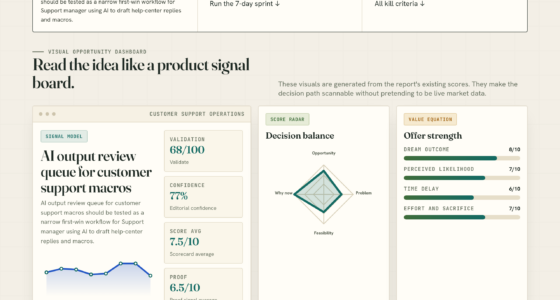

📊 Full opportunity report: The Impact Of OpenAI’s Data Stack On AI-Driven Business Innovation In 2026 on ThorstenMeyerAI.com — validation score, market gap, and execution plan.
TL;DR
OpenAI has expanded its enterprise offerings in 2026, emphasizing data governance and security. New products enable AI agents to search, act, and integrate with internal systems without training on business data by default, boosting innovation while maintaining control.
OpenAI has expanded its enterprise AI platform in 2026 with new products that enable AI agents to search, retrieve, and act across internal business systems while maintaining strict data governance. The company affirms it does not train its models on customer data by default, emphasizing control and security for business users. This development signifies a shift toward AI systems that support complex enterprise workflows without compromising data privacy.
OpenAI’s latest product suite includes Company Knowledge, Frontier, Presence, Secure MCP Tunnel, and ChatGPT Work. These tools allow organizations to deploy AI agents capable of conducting searches across internal platforms such as Slack, SharePoint, and GitHub, and performing actions within secure boundaries. OpenAI states it does not automatically use business data for model training, although explicit customer opt-ins for feedback may allow data to be used for model improvement.
This approach is underpinned by multiple controls, including data retention policies, regional storage, inference boundaries, and auditability. The company emphasizes that data processed by these systems remains under enterprise control, with encryption at rest and in transit, and that the primary goal is to enable secure, productive AI workflows. The new stack also introduces AI agents with distinct identities and permissions, enhancing security and operational clarity.
Enterprise data governance · July 2026
Inside OpenAI’s Enterprise Data Stack
What happens to company data when ChatGPT and AI agents search internal apps, run tools and work across private systems.
Applies to covered business products and the API; explicit opt-in can change the rule.
Storage at rest for eligible Enterprise and Edu customers.
Europe, United States and UAE for eligible configurations.
Eligible customers can apply for Modified Abuse Monitoring or Zero Data Retention.
01 · Four separate questions
“No training” is not “no storage”
A credible review separates model training, service processing, data retention and access control.
Training
Used to improve future models?
OpenAI says business data is not used for training by default. Explicitly shared feedback may be used when a customer opts in.
Default · ExcludedProcessing
Handled to produce an answer?
Prompts, files and retrieved context must be processed for inference, safety checks and the requested tools to work.
Required for the serviceRetention
Stored after processing?
The answer varies by plan, feature, endpoint, chat settings, synchronized index and approved data-retention control.
Configuration dependentAccess
Who can retrieve or act?
Workspace roles, app permissions, agent identity and tool policies determine what context is visible and what actions are allowed.
Permission controlled02 · The new enterprise stack
From protected chat to governed agents
OpenAI’s recent products add internal search, agent identity, private connectivity and execution.
October 2025
Company Knowledge
Searches across connected apps, respects source permissions and returns citations to original material.
RetrieveFebruary 2026
OpenAI Frontier
Builds and manages AI coworkers with separate identities, explicit permissions, guardrails and feedback.
GovernMay 2026
Secure MCP Tunnel
Connects supported products to private or on-prem MCP servers without a public server endpoint.
ConnectJuly 2026
ChatGPT Work
Works across apps and files, runs multi-hour assignments and turns goals into finished deliverables.
ActJuly 2026
OpenAI Presence
Deploys production voice and chat agents across customer-facing and internal operational workflows.
Operate2026 control layer
Compliance + Review
Provides prompts and responses for oversight; auto-review can inspect important actions before execution.
ObserveThe strategic shift
More context → more useful agents → more governance required
03 · Connected data flow
Permissions travel with the user
ChatGPT should retrieve only what the authenticated user or agent identity may already access.
Identity
User or AI coworker
Permission
Role + source ACLs
Retrieval
Apps + private tools
AI inference
Answer, artifact or action
Where new state can appear
Chat history
Conversations, files, memory and custom GPT content follow workspace retention settings.
Policy controlledSynced index
App data with sync can be indexed to accelerate answers. Region support must be checked.
App dependentAPI state
Abuse logs, stored responses, files and containers have endpoint-specific lifecycles.
Endpoint dependentThird parties
Remote MCP servers and other tools apply their own retention and security policies.
Separate processor04 · Location controls
Storage residency ≠ inference residency
The region used to save covered content can differ from the region where GPU inference runs.
Data residency · Storage at rest
- Europe (EEA + Switzerland)
- India
- United States
- Japan
- United Kingdom
- Singapore
- Canada
- South Korea
- Australia
- United Arab Emirates
Chats · files · memory · custom GPTs · analysis artifacts · image inputs and outputs
Inference residency · GPU execution
- Europe
- United States
- United Arab Emirates
05 · Claims vs. operational reality
What each control actually answers
06 · Enterprise buyer checklist
Govern the workflow, not only the model
For every deployment, record the complete chain of access, state and accountability.
- Product, model and exact enabled features
- Retention setting for every endpoint
- Connected sources and synchronized indexes
- Storage region and inference region
- User or agent identity and allowed actions
- Third-party processors and audit coverage
Implications of OpenAI’s Data Governance for Business Innovation
OpenAI’s focus on strict data governance and new enterprise AI tools in 2026 significantly impacts how businesses adopt AI. By ensuring data is not automatically used for training and providing granular control over data access and retention, organizations can innovate confidently without risking data leaks or compliance violations. This shift supports broader enterprise AI integration, enabling more complex workflows and automation while maintaining security and privacy standards.

The Developer's Playbook for Large Language Model Security: Building Secure AI Applications
As an affiliate, we earn on qualifying purchases.
As an affiliate, we earn on qualifying purchases.
Evolution of OpenAI’s Enterprise Data and AI Capabilities
Since 2025, OpenAI has transitioned from offering protected chat interfaces to a comprehensive enterprise AI platform. The introduction of Company Knowledge allowed AI to access internal data sources securely, while Frontier extended this to managed AI agents with explicit permissions. The Secure MCP Tunnel, launched in 2026, further enhances security by connecting internal systems without exposing them publicly. These developments reflect a strategic move toward embedding AI deeply into enterprise workflows with a focus on data security and governance.
Throughout 2026, OpenAI has emphasized that its models are not trained on customer data by default, with explicit opt-in for data sharing. The company’s product strategy now involves layered controls—training exclusion, permissions, retention, and auditability—to address enterprise security concerns and foster trust in AI deployment.

Scaling AI: The AI Governance and Security Playbook for Executives
As an affiliate, we earn on qualifying purchases.
As an affiliate, we earn on qualifying purchases.
Outstanding Questions on Data Use and Security Boundaries
It remains unclear how widely enterprises will adopt these new controls and whether any unanticipated data retention practices might emerge. The long-term impact of explicit opt-ins and safety monitoring on data privacy is still being evaluated, and the effectiveness of permission models in preventing misuse or leaks is yet to be fully tested in diverse real-world scenarios.

The Enterprise Integration Architect Designing Secure, Resilient, and AI-Ready Digital Platforms
As an affiliate, we earn on qualifying purchases.
As an affiliate, we earn on qualifying purchases.
Next Steps for Enterprise AI Integration and Regulation
OpenAI is expected to continue refining its enterprise product suite, with upcoming updates focused on enhancing security, compliance, and usability. Regulatory bodies may scrutinize these developments further, influencing enterprise adoption. Meanwhile, organizations will likely pilot these tools in high-stakes environments to validate their security and operational benefits.

How AI Agents Work: Tools, Memory, and Autonomous Decision-Making (The AI Security & Hacking Bible: Protect and Exploit LLMs and Autonomous Agents)
As an affiliate, we earn on qualifying purchases.
As an affiliate, we earn on qualifying purchases.
Key Questions
How does OpenAI ensure data privacy in its new enterprise products?
OpenAI states it does not train models on customer data by default and employs encryption, regional storage, and strict access controls to protect enterprise data. Data retention depends on product and feature settings, with audit logs and permissions designed to prevent misuse.
Can enterprise data be used to improve OpenAI models?
Yes, but only if customers explicitly opt in through feedback mechanisms. By default, data from enterprise interactions is not used for training, emphasizing a privacy-first approach.
What new security features are included in OpenAI’s 2026 enterprise stack?
Key features include the Secure MCP Tunnel for private system connections, agent identities with permissions, and comprehensive auditability. These tools help organizations control what AI can access and do within their internal systems.
How might these developments impact AI adoption in regulated industries?
The enhanced controls and security features could accelerate AI deployment in sectors like healthcare, finance, and government, where data privacy and compliance are critical, provided organizations trust the governance measures.
What challenges remain for enterprise AI security in 2026?
Despite improvements, challenges include ensuring permissions are correctly configured, preventing data leaks through connected apps, and maintaining compliance amid evolving regulations and threat landscapes.
Source: ThorstenMeyerAI.com